Acoustic Evidence for Partial Temporal Restoration in Syllable and Segmental Deletion in Igbo
DOI:
https://doi.org/10.60787/jolan.vol6no1.476Keywords:
compensatory lengthening, temporal restoration, segment deletion, syllable deletion, acoustic phonetics, IgboAbstract
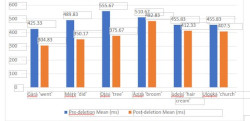
Compensatory lengthening is commonly described as a process in which the deletion of a segment or syllable is accompanied by the lengthening of an adjacent segment. This study examines the acoustic evidence for partial temporal restoration following syllable and segment deletion in Igbo. Speech data were obtained from six adult native speakers of Igbo, comprising three males and three females. The speakers produced selected words and utterances representing different phonological environments in which segmental or syllabic deletion occurs. The recordings were analysed acoustically using Praat, with particular attention to the duration of the segments and syllables involved before and after deletion. The analysis shows that deletion is frequently accompanied by an increase in the duration of an adjacent vowel. However, the measured duration of the lengthened vowel does not consistently equal the combined duration of the deleted sequence and the vowel that remains. The acoustic evidence therefore points to partial rather than complete temporal restoration. The findings suggest that, although vowel lengthening contributes to the recovery of temporal material following deletion, it does not necessarily reproduce the full duration of the original sequence. The study provides acoustic evidence that explains the occurrence of compensatory lengthening and the degree of temporal restoration achieved through the process.
References
Boersma, P. and Weenink, D. (2025). Praat: Doing phonetics by computer (version 6.2,08). Retrieved from http://www.praat.org on 6th January, 2026.
Crystal, D. (2007). A Dictionary of Linguistics and Phonetics (6th ed). Australia: Blackwell Publishing.
Downing, L. J. (2005). Canonical Forms in Prosodic Morphology. Oxford: Oxford University Press.
Emenanjo, E. N. (1978). Elements of Modern Igbo Grammar. Ibadan: Oxford University Press.
Gordon, M. (2016). Phonological typology. Oxford University Press.
Gouskova, M., and Stanton, J. (2020). The Phonology of Nonconcatenative Morphology. Oxford: Oxford University Press.
Green, D. J., and Igwe, C. U. (1963). The Igbo Language: An Introductory Grammar. Ibadan: Oxford University Press.
Hayes, B. (1989). Compensatory lengthening in moraic phonology. Linguistic Inquiry, 20(2), 253–306.
Acoustic Evidence for Partial Temporal Restoration …
Hyman, L. M. (1985). A Theory of Phonological Weight. Foris Publications.
Hyman, L. M. (2009). How (not) to do phonological typology: The case of pitchaccent. Language Sciences, 31(2–3), 213–238.
Hyman, L. M. (2018). Towards a Typology of Postnatal Voicing. Phonology,35 (2), 241-271.
Johnson, K. (2012). Acoustic and auditory phonetics (3rd ed.). Wiley-Blackwell.
Kavistskaya, D. (2002). Compensatory Lengthening: Phonetic, Phonology, Diachrony. New York: Routledge.
Kent, R. D. and Read, C. (2002). The Acoustic Analysis of Speech (2nd ed.). Singular Publishing Group.
Ladefoged, P. and Johnson, K. (2015). A course in phonetics (7th ed.). Cengage Learning.
Mbah, E. E. and Mbah, B. M. (2010).Topics in Igbo Syntax and Semantics. Nsukka: Nsukka University Press.
McCarthy, J. J. and Prince, A. (1986). Prosodic Morphology. Ms., University of Massachussets, Amherst, and Brandis University.
Reetz, H., and Jongman, A. (2009). Acoustic Analysis of Speech: A Practical Tutorial. Wiley-Blackwell.
Downloads
Published
How to Cite
Issue
Section
License
Copyright (c) 2026 Journal of The Linguistic Association of Nigeria

This work is licensed under a Creative Commons Attribution-NonCommercial-ShareAlike 4.0 International License.