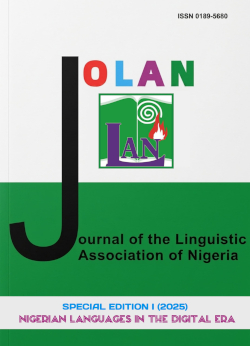
Nigerian Languages in the Digital Era: Challenges and Opportunities
DOI:
https://doi.org/10.60787/jolan.vol6no1.462Keywords:
Nigerian languages, digital era, endangered languages, resources, challengesAbstract
The UNESCO Ad-Hoc Expert Group on Endangered Languages (UNESCO, 2003) notes that the capacity of a language to readily expand into new media, including broadcast media and the Internet, is a critical parameter for assessing its vitality. It notes further that this capacity usually serves “only to expand the scope and power of the dominant language at the expense of endangered languages” (p. 11). Nigerian languages, in general, have struggled to secure a place in the digital space and, for most of them, the “response to new domains and media” (UNESCO, 2003, p. 17) is slow or inexistent. This paper explores the challenges and opportunities the digital age presents for Nigeria’s indigenous languages. It first reviews the current state of Nigerian languages in the digital era, and then identifies digital tools and resources that are available for Nigerian languages. Thereafter, it identifies the challenges to integrating Nigerian languages into the digital ecosystem and then highlights the potential and opportunities that digital tools and resources offer to Nigerian languages in a rapidly globalising world. It then proffers suggestions and recommendations for positioning Nigerian languages to take advantage of opportunities in the digital era.
References
Abate, S. T., Tachbelie, M. Y., & Schultz, T. (2020). Deep neural networks based automatic speech recognition for four Ethiopian languages. In ICASSP 2020 – 2020 IEEE International Conference on Acoustics, Speech and Signal Processing (ICASSP), Barcelona, Spain, 2020, pp. 8274-8278. doi: 10.1109/ICASSP40776.2020.9053883.
Abubakar, A. M., Gupta, D., & Vekkot, S. (2024). Development of a diacritic-aware large vocabulary automatic speech recognition for Hausa language. International Journal of Speech Technology, 27(3), 687–700.
Anderson, G. D. S., Arokoyo, B. E., & Harrison, K. D. (2015). Olùkùmi talking dictionary. Living Tongues Institute for Endangered Languages. Retrieved
from http://talkingdictionary.swarthmore.edu/olukumi
Arokoyo, B. E. (2025). From the mouths of babes to the wisdom of elders: A voyage of language exploration. The two hundred and eighty-second (282nd) inaugural lecture, University of Ilorin, Nigeria.
Aworinde, H. O. (2025). EdTech for Naija tongues: How digital tools van revive Nigerian languages in basic education. Paper presented at a four-day workshop on promoting the use of Nigerian indigenous languages in basic education: Prospects and challenges, University of Jos.
Bamgbose, A. (2016). Language provisions of Nigeria's national policy on education: Declaration without implementation. NILAS – A Journal of the National Institute for Nigerian Languages, Aba, 3(1), 5-13.
Dossou, B. F. P., & Emezue, C. C. (2021). OkwuGbé: end-to-end speech Recognition for Fon and Igbo. In E. Varis et al (Eds.), Proceedings of the fifth workshop on widening natural language processing (pp. 1-4). Punta Cana, Dominican Republic: Association for Computational Linguistics.
Ekekwe, N. (2025). AI data annotation opportunity in Nigerian languages. Tekedia Institute. Retrieved from https://tkcdn.tekedia.com/wp- content/uploads/2025/ 07/09220523/AI-data-annotation.pdf
Eze, N. J. (2023). Effect of information and communication technology (ICT)implementation in the teaching of Igbo language grammar to Igbo language students. The NOUN Scholar, 3(2), 355-371.
_____________________________________________________________________
Ezeamalukwue, I. R., Akinremi, I. I., & Danjuma, L. N. (2023). Globalisation and language use: A comparative study of indigenous Nigerian languages on BBC Igbo and BBC Yoruba Facebook platforms. Language Review: An International Journal of Linguistics (LRIJL), 2(1), 77-94, DOI : https://doi.org/10.5281/zenodo.18334447
Fagbolu, O., Ojoawo, A., Ajibade, K., & Alese, B. (2015). Digital Yorùbá Corpus. International Journal of Innovative Science, Engineering & Technology (IJISET), 2(8), 916-926.
Hussen, K. Y., Sewunetie, W. T., Ayele, A. A., Imam, S. H., Alemu, E. N., Muhammad,
S. H., & Yimam, S. M. (2025). The state of large language models for African languages: Progress and challenges. Retrieved from https://arxiv.org/pdf/2506.02280
Imam, S. H., Sani, B., Gete, D. K., Ahamed, B. Y., Ahmad, I. S., Abdulmumin, I., Yimam, S. M., Bello, M. Y., and Muhammad, S. H. (2025). Automatic speech recognition for African low-resource languages: Challenges and future directions. Retrieved from https://papers.cool/arxiv/2505.11690
Muhammad, S. H., Ahmad, I. S., Abdulmumin, I. Lawan, F. I., Sani, B., Imam, S. H., Aliyu, Y., Sani, S. A.., Umar, A. U., Gwadabe, T., Church, K., & . Marivate, V., (2025). Hausa NLP: Current status, challenges and future directions for Hausa natural language processing. Retrieved from https://arxiv.org/pdf/2505.14311
Nwafor, E., & Nguyen, M. P. (2025). Fostering digital inclusion for low-resource Nigerian languages: A case study of Igbo and Nigerian Pidgin. Proceedings of the Eighth Workshop on Technologies for Machine Translation of Low-Resource Languages (LoResMT 2025), pp. 44–53. Association for Computational Linguistics.
Nwamini, S. C., Nwankwegu, J. A., Nwode, G. C., Nwofe, W. O., & Ogbonna, O. J. (2025). Digitising Igbo culture of communication in the era of digital media for the preservation of Igbo culture and identity. Ideal International Journal of Igbo Scholars Forum for Socio-Cultural Advancement, 18(3), 84-107.
Nwankwegu, J. A. (2021). Leveraging digital technology for Igbo language development. Ideal International Journal, 14(2), 20-32. Retrieved from https://acjol.org/index.php/ideal/issue/view/437
Okoye, A. (2022). Electronic resources and literacy skill in Igbo. In M. E. Ekpenyong, & I. L. Udoh (Eds.), Current issues in descriptive linguistics and digital humanities (pp. 697-704). Singapore: Springer.
Sani, Ahmad, & Abdulazeez (2022). Sentiment analysis of Hausa language tweet usingmachine learning approach. Journal of Research in Applied Mathematics, 8(9), 7-16.
Udoh, I. (2021). The empowerment of Nigerian languages for sustainable development. In H. Adeniyi, G. O. C. Obiamalu & T. Olagunju (Eds.), Interdisciplinary approaches to the study of African languages: Essays in honour of Francis Egbokhare (pp. 32-49). Ibadan: Free Enterprise Publishers.
Udoh, I. (2023). Globalization and the preservation of Nigerian languages. In H. Adeniyi, G. O.
C. Obiamalu, & T. Olagunju (Eds.), Interdisciplinary approaches to the study of African languages: Essays in honour of Francis Egbokhare (pp. 161-169). Lagos: Free Enterprise Publishers.
Ukaegbu, N. M., & Obiagboso, C. (2025). Exploring the use of digital resources and tools in improving Igbo language learning in Nigerian universities. Nsukka Journal of the Humanities,33(1), 71-86.
UNESCO Ad Hoc Expert Group on Endangered Languages (2003). Language vitality and endangerment. https://unesdoc.unesco.org/ark:/48223/ pf0000183699
Yusuff, A., Adétọ̀míwá, A., & Adédèjì, O. (2020). Yorùbá Language Development and Digital Communication: Ability, Capacity, and Capability. UNILAG Journal of Humanities, 8(1), 149-165.
Downloads
Published
How to Cite
Issue
Section
License
Copyright (c) 2026 Journal of The Linguistic Association of Nigeria

This work is licensed under a Creative Commons Attribution-NonCommercial-ShareAlike 4.0 International License.